- NO.
- 033
- DATE
- READ
- ~12 min
- KIND
- Case study
- STATUS
- Reviewed
Hide or Show the Factory: A B2B Sourcing Site
18 ADRs from five months of a B2B sourcing site: factories go from hidden to shown, the category changes four times, and agents work behind gates.
This is a look back at a B2B sourcing site, from its first architecture decision record in May 2026 (ADR: a short document that records why a decision was made) to its technical launch on October 29. "Technical launch" means the site opens from a direct link, but search engines are told not to index it and the inquiry form doesn't accept submissions yet. So there is no traffic or inquiry data here, only decisions and engineering. The brand, domain, product categories and partner factory are left out.
Over five months the project produced 18 ADRs, 4 Git repositories and a Feishu workspace (Feishu is ByteDance's workplace suite, sold internationally as Lark). Laid out by date, the changes run along three lines: whether the factory appears on the site, what the first product category is, and how many domains the site is split across. A fourth column tracks how the collaboration setup changed over the same months; it gets the last section.
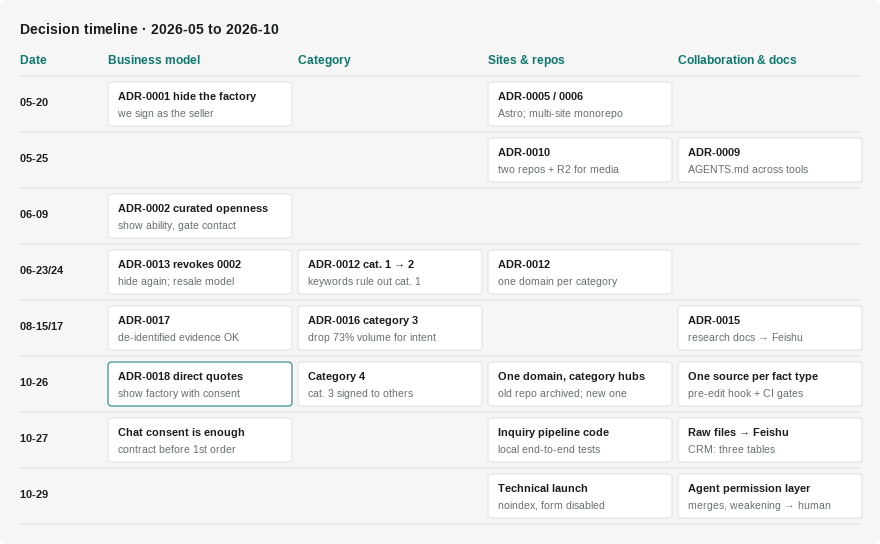
Whether the factory shows follows the contract
The first record, ADR-0001 (May 20), set "zero factory signals on the front end": no page shows a factory's name, address, exterior or original company certificates, and no copy like "our partner factory" points to a specific producer. The record gives two reasons. One is preventing bypass: with no factory name in the page source, a buyer can't search for the factory and compare prices directly. The other is legal caution: if we never claim to be the manufacturer, we can't be accused of misrepresentation. The cost is written in the same record: a fully de-identified site lacks brand authority signals, and conversion runs cold.
June went back and forth. ADR-0002 (June 9) switched to "curated transparency": show the factory's name, city, certifications and workshop photos, but not its contact details, online store links or prices. Its principle was "show capability, control contact." Two weeks later ADR-0013 (June 24) revoked it and went back to zero factory signals. The trigger was the category chosen at the time: low unit value, all standard parts, almost every factory already selling on B2B marketplaces, and professional buyers who compare prices. ADR-0013 checked these four factors one by one against ADR-0002's assumptions and concluded that this combination carried the highest bypass risk, so the factory needed hiding all the more. To make up for cold conversion, it used certification wording that points to no specific factory, such as "made in an ISO 9001-certified production network" rather than "our QC team", because the project itself has no process-level quality inspection. The same ADR set the profit model as resale, with us as the contract seller.
In August, ADR-0017 loosened one notch: de-identified production photos tied to a specific product and a specific process step may be published, but only when 7 conditions all hold, including authorization from whoever owns the material, removal of everything that could locate the factory, stripped EXIF data, and a reverse image search on every derived image. Zero factory signals still govern the factory's identity, but no longer rule out every real production image.
ADR-0018 on October 26 turned the whole line around. The new fact was that, for now, there isn't enough money or risk buffer to act as the contract seller: no sales contracts, no collecting payment, no liability for quality. In the ADR's own words, "every reason for hiding the factory rests on the buyer signing with us." Without that contract, the buyer learns who the factory is at the quoting stage anyway, and hiding it on the site is pure cost. So the model became direct quotes. The factory handles quoting, contracts, payment, production and after-sales. We handle finding buyers, organizing requirements, English communication and order follow-up, and take a commission from the factory on closed deals.
Whether the factory shows up on the site is not a standalone branding choice; it is decided by who acts as the contract seller. Put the two records side by side: the factory information ADR-0018 allows (name, city, processes, authorized photos) and what it forbids (contact details, prices, MOQ) are nearly the same as in ADR-0002, which was revoked in June. What appears on the page barely changed. What changed is who signs the contract. In June we still planned to be the contract seller, so showing the factory meant handing buyers a way around us.
The old approach wasn't deleted; it became data. Each factory has disclosure: public | hidden, and hidden factories are still handled under ADR-0001 and ADR-0017. Each category has deal_model: direct_quote | resale, and the page copy about who quotes and who signs is generated from it. Switching back to resale later means changing data, not architecture. The risks the new model accepts are listed too. Once buyers know the factory they may go around us; inquiry IDs, a de-identified brief sent before any introduction, and a cooperation memorandum are meant to reduce that. And with only one partner factory, the project depends on it entirely.
The first category changed four times
All the candidate categories were steel products. On this line, every change was triggered by a new fact:
- Category 1 was a niche accessory. June's keyword data ruled it out: nearly all the big related terms carried consumer intent, very few carried procurement words like supplier or wholesale, and ad bids were under $1 (ADR-0012).
- Category 2 was a standard product that folds flat for shipping (ADR-0012, June 23). The case for it was mostly on the delivery side: many sets fit in one container, so ocean freight per set stays low; buyers install it themselves, so there are no disputes over drawings; and the partner factory's catalog already showed the capacity. It was also exactly the highest-bypass-risk combination from the previous section.
- Category 3 was a project-based component system with a high order value (ADR-0016, August 16). This ADR says outright that it "deliberately gives up 73% of the search volume in a third-party report." The high-volume adjacent terms had high keyword difficulty and low ad bids, which points to traffic rather than purchase intent. Category 3 had low difficulty, high bids, and enough variation in specifications to support real spec pages.
- Category 4 (ADR-0018, October 26). Category 3's premise had failed: the partner factory had already signed with other traders for that kind of product. The new category came out of a business partner's keyword research in October: difficulty from single digits to the mid-teens, ad bids above neighboring categories, buyers who mostly order by the full container, and the most complete evidence of this product line among the factory's photos.
Because the trade-off was counterintuitive, ADR-0016 wrote down the premises it rested on and the conditions that would overturn it. One premise was that the main supplier could keep supplying this category, and that is the one that failed in October. With the premises on paper in advance, overturning the decision didn't mean re-arguing all of it, only checking which premise no longer held.
From five domains to one
Site structure was the third line. May's ADR-0006 designed a monorepo (one repository holding several site projects): a shared theme and components, and one site with its own domain per vertical category, five sites planned. June's ADR-0012 and the later ADR-0014 went further, to one domain per category plus a neutral company brand site. The design followed the same logic as hiding the factory: each site looks like an independent product brand, with no visible link between sites or between any site and the factory.
ADR-0018 changed this to one domain, one site, and category hubs. The home page explains who we are and how working together works. Each category gets a hub page, and each product page sits under exactly one hub. Public factories get profile pages in a subdirectory, not a subdomain. The reasoning: a new domain has no history at all, so authority has to build up on one site, and deploys and DNS are maintained once. When to split again is written as observable triggers. A new category needs at least 5 SKUs with parameters confirmed by the factory and a set of keywords with difficulty of 20 or less. A new standalone domain needs one category to bring at least 10 qualified inquiries a month for 3 months running, plus evidence that the umbrella brand is dragging down conversion.
The old multi-site repository wasn't migrated; it was frozen and archived. ADR-0018 judged that its hide-the-factory checks, review-prototype rules and multi-vertical scaffolding all served the old model, and porting them would cost more than rebuilding. The new site repository was created on October 26 and reached technical launch three days later. The stack is Astro 6 static output plus Cloudflare Workers, with content maintained in Sveltia CMS (an editing interface that reads and writes the Git repository directly, with no database).
Working with coding agents: one source per kind of fact
From May on, the project was organized around working with coding agents, meaning AI tools like Claude Code that read and write code in a terminal. ADR-0009 made AGENTS.md the agent context shared across tools. The most common failure in this kind of collaboration isn't wrong code; it's an agent reading stale facts. The workspace's entry file records an example: on August 16, the copies of the entry file on two machines were both stuck on old state like "Astro 5, ADR-0015 undecided", all of it wrong. After that, the entry file kept only local paths and pointers to documents inside the repositories.
A cleanup on October 26 set the rule that each kind of fact has exactly one source:
| Fact | Single source |
|---|---|
| Why a decision was made | ADR |
| Current status, schedule, open questions | ROADMAP |
| Domain terms | CONTEXT |
| Collaboration rules and gates | CONTRIBUTING |
| Where assets are and whether they can go public | Asset register |
| Raw files (catalogs, photos, contracts) | Feishu Drive, not Git |
Old documents that a new source replaced were deleted outright, with the commit hash from before the deletion noted in the CHANGELOG, so they can be recovered from Git history when needed.
The split between Feishu and Git was set in August by ADR-0015. Research write-ups moved to the Feishu knowledge base, because they need comments and their readers include partners who don't write code. Rules, state and decisions stayed in Git, because they need diffs and agents can read them straight from the terminal. When the factory's raw files moved into Feishu Drive in October, all 130 photo files were checked one by one, and the local copy of the product catalog matched the Feishu original by SHA-256.
A source table alone isn't enough; the agents also have to actually read it, and follow the rules when they change things. The project set gates at three points, and deploy day ran into a fourth:
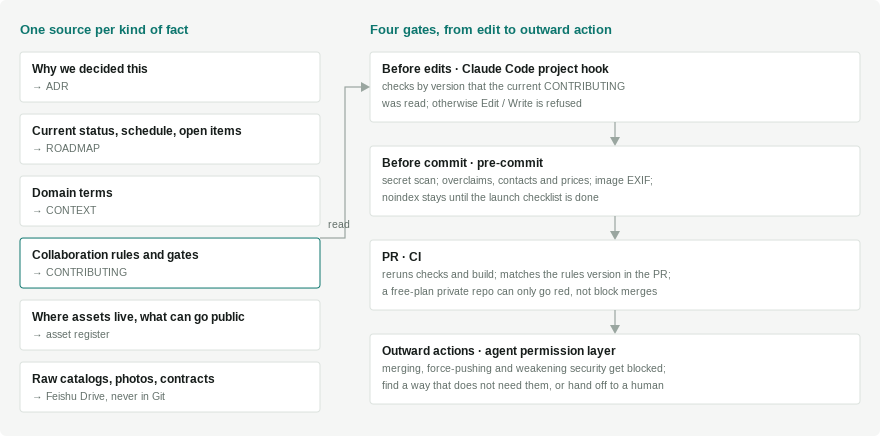
- Before edits: a Claude Code project hook records "read" by version number. If the agent hasn't read the current version of CONTRIBUTING, Edit and Write are refused. Every change to the rules file bumps the version, and every agent has to read it again.
- Before commit: pre-commit runs a secret scan, then a content check script. The script blocks overreaching claims like "our factory" and "we guarantee" and any wording for contacts, prices or MOQ, checks image dimensions and EXIF, and refuses to lift noindex while the launch checklist isn't fully ticked.
- On the PR: CI reruns the same checks and the build, and compares the CONTRIBUTING version cited in the PR description. A private repository on GitHub's free plan can't use branch protection, so a failing CI only shows a red X and can't stop a merge. What really blocks things is the local hooks and human review.
The fourth gate came from the agent's own permission layer. On deploy day, the agent tried to force-push a rebased branch, to merge a PR directly, and to swap the production bot-check secret for a test value temporarily so it could run an end-to-end test. All three were blocked. The force push was replaced with an approach that doesn't rewrite history (merging main into the branch). The merge was handed to a human, who ran it in the session. The third wasn't worked around: the production database write went into ROADMAP as untested, to be verified with one real submission when the form opens. When an action is blocked, either switch to an approach that doesn't need it or hand it back to a human; don't go looking for a way around.
For how to design a hook's checks, see Hooks for Coding Agents; for a docs cleanup in another project, see the docs that grew back after slimming down (in Chinese).
Where things stand
As of October 29, the site runs in a Cloudflare account created just for this business, every page is noindex, and the form can be viewed but not submitted. The inquiry pipeline (bot check, Worker, D1 database, Feishu group alerts) is deployed; its structure and what was verified are in Serverless B2B Inquiries. A few things remain before going public: the factory's written consent to be shown, a final privacy policy, access control on the admin, a trademark search, and search engine setup.
ADR-0018 set its own review conditions: within 90 to 120 days of launch, at least 3 qualified inquiries, at least 1 of them from organic search on a non-brand term, and at least 1 that the factory can assess from a de-identified brief. If it falls short, first work out whether it is stuck on traffic, conversion or the factory's response, then decide whether to change the category or the channel, rather than simply putting in more.
Limits
This post is based on the project repository's ADRs, ROADMAP, CHANGELOG and commit history, plus the session log from deploy day. ADR content is paraphrased; quoted wording is translated from the original Chinese. There is no traffic, inquiry or cost data, so the post doesn't discuss how well these decisions worked. The brand, domain, category names, partner factory and account details are left out.
Writing note: Claude Opus 5.5 drafted it, drew the figures and translated it; the author decided to publish.
Comments
Comments are powered by GitHub Discussions. Sign in with GitHub to comment. Open the matching Discussion