- NO.
- 030
- DATE
- READ
- ~14 min
- KIND
- Notes
- STATUS
- Reviewed
The insight was true, the theory too neat
An AI caught one correct local judgment and completed it into a whole theory. How a devil's-advocate prompt took the pretty version apart, and what survived.
It started with a marketing funnel diagram, and I nearly believed a very complete-looking "precise customer filtration model."
Then I did something simple:
Argue the other side.
Most of the pretty structure came down within minutes.
Not all of it, though. What survived was the local judgment that had been sound from the start:
In high-value B2B you cannot chase traffic alone; you have to identify the accounts worth resourcing and go after them.
The part worth writing down turned out not to be the funnel at all:
The hard failure mode is not an AI confidently inventing something false.
It is an AI catching hold of something true, and then completing the story around it until the whole thing looks finished.
Finished enough that I nearly promoted a decent explanation into an established theory.
It began with an unremarkable funnel
I came across a marketing funnel diagram online — the classic shape:
Awareness
    ↓
Interest
    ↓
Consideration
    ↓
Decision
    ↓
Conversion
Fewer people at every level down. A small share become customers at the bottom.
I have seen that diagram more times than I can count, but this time a question surfaced: for high-ticket B2B, is the model actually accurate enough?
Think industrial equipment, enterprise software, supply-chain services.
A site might take 100,000 visits in a month. Among them:
- students;
- competitors;
- people doing research;
- people who could never afford it;
- people in completely mismatched markets;
- people with no current purchasing need.
Meanwhile perhaps a few dozen companies genuinely match the target profile — and closing a handful of those can outweigh all the ordinary traffic above.
Seen that way, the question worth asking is not only:
How many people fell from the top of the funnel to the bottom?
but also:
Who is worth continued investment?
Who simply has no need right now?
Which companies match our ideal customer profile?
Which high-value accounts are worth approaching directly?
So I handed the idea to an AI.
The early exchange was reasonable
We started on SEO, inbound and outbound.
If SEO requires actively researching keywords, running competitive analysis, building pages, producing content and wiring internal links — why is it called inbound?
That one has a clean answer:
Inbound and outbound describe which side initiates the commercial contact, not how active the marketer's work is.
When the buyer searches:
Google search
    ↓
sees my page
    ↓
enters the site
    ↓
sends an inquiry
That is textbook inbound. The reverse:
I pick Company A
    ↓
research it
    ↓
find procurement / engineer / owner
    ↓
cold email / LinkedIn / phone
That is closer to outbound.
Then, on high-ticket B2B, I put it this way:
If I can already identify valuable target companies, why wait for them to find me through SEO?
Isn't going after them directly more sensible?
Nothing wrong with that either. Mature B2B marketing already has a name for it: account-based marketing, or ABM.
Salesforce defines ABM as personalised marketing and sales aimed at specific high-value accounts in order to build deeper relationships. Its framing sets ABM against traditional lead generation — you start by picking the accounts you want to convert rather than filling a funnel and sieving it afterwards. Whether the two are complements or substitutes, that page does not say; I lean towards complements, for reasons that only become clear later in this piece.
So far, so fair:
more traffic
≠
more inquiries
≠
more qualified customers
≠
more high-value customers
The trouble came next.
Then the AI made the idea bigger
The AI took hold of "high-value B2B should keep identifying and selecting the customers worth resourcing" and kept pushing in that direction.
Its explanation: the traditional marketing funnel only shows quantity shrinking, whereas real marketing should be understood as layer-by-layer filtration.
Awareness filters out non-target audiences.
Interest filters out the uninterested.
Evaluation filters out those with no budget, no authority, no fit.
Decision filters further.
What remains is a small group of "true precise customers."
Then it generated a diagram.
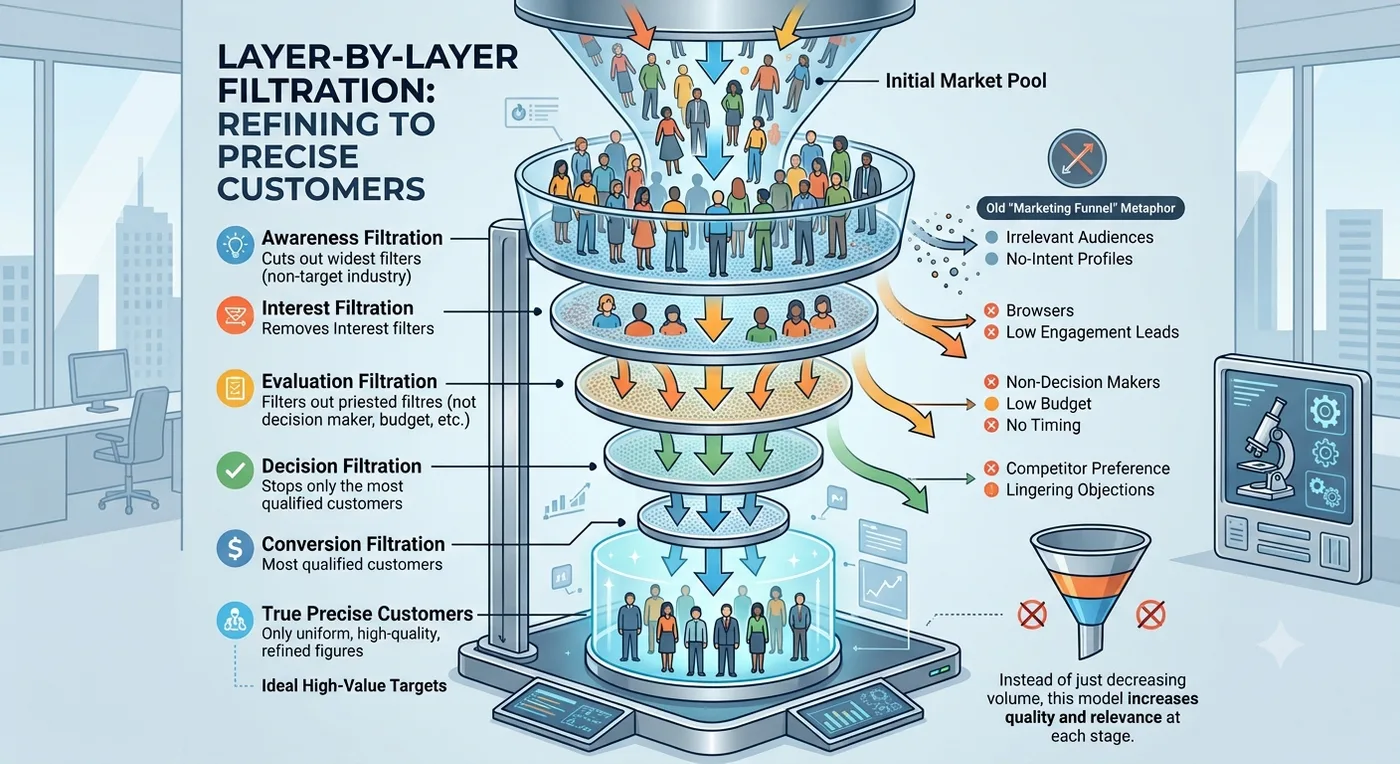
Five filters, colour-coded, unqualified customers flying off to the right, a row of genuinely precise customers standing at the bottom. It even added a line:
Instead of just decreasing volume, this model increases quality and relevance at each stage.
I have to admit the diagram changed how the whole thing felt. At first glance it reads as entirely sensible — even as "oh, so this is what the funnel really means."
Worth noting: the diagram does not survive a close look. The Interest layer's caption reads "Removes Interest filters," Evaluation says "Filters out priested filtres," and Decision's "Stops only the most qualified customers" states the opposite of the intent. None of that stops it looking credible at a glance — which is precisely the subject of this piece.
But the longer I looked, the more something felt off.
Was it just agreeing with me?
A question surfaced: had it independently concluded this was a better model of marketing, or was it rounding out a story because I had already signalled approval of the direction?
From the finished text, those two cases are very hard to tell apart.
So I did not ask "how could this model be improved." I realised what that question would produce:
- Precise Marketing Framework;
- Account Intelligence Layer;
- Dynamic Intent Filtering;
- AI Qualification Engine;
- a full metric set;
- and a few more attractive diagrams.
The building would keep going up. What I wanted to know was whether there was a foundation under it.
So I turned the other way:
Argue the other side.
More precisely: assume the conclusion "marketing is fundamentally the layered filtering of precise customers" is wrong, then attack it.
The theory started leaking almost immediately.
Cut one: isn't this still the funnel?
Look at the stages again: awareness, interest, evaluation, decision, conversion.
Those are the classic funnel stages. The only change is the narration. Before: some people did not proceed to the next stage. Now: I actively filtered out those who did not qualify.
Drop-off became filtration, and the story got more sophisticated. Did the substance change? Not much.
Marketing and sales already have qualification: is there a need, does it fit the ICP, is there budget, is there purchasing capability, is it worth a rep's continued time. None of that was discovered by the filtration model.
After the first pass, the honest name for this "new model" is not a new marketing model but the qualification mechanism inside the funnel, pulled out and magnified.
Still useful. But:
Renaming an existing mechanism is not the same act as discovering an underlying law.
Cut two: "purer at every layer" nearly proves itself
The most attractive sentence in the filtration model is that customer quality rises at every layer.
Sounds unobjectionable. Then: what counts as a high-quality customer?
If the definition is "closer to closing means higher quality," then:
delete those not close to closing
        ↓
those remaining are closer to closing
        ↓
therefore those remaining are higher quality
That is a tautology.
It shows the average close probability of the remaining sample went up. It does not show that commercial value across the market increased. Selection and improvement are different things.
Take a deliberately extreme case (the numbers below are an illustrative example built to show the mechanism, not data from a real project). Say I have 1,000 potential accounts. Delete everyone with no current budget, no timing this year, a contact who is not the final decision maker, or low recent engagement. Perhaps 30 remain.
My reporting now looks excellent:
MQL → SQL conversion ↑
average lead score ↑
sales efficiency ↑
Six months later, one of the accounts I deleted for "no timing" starts a project worth several hundred thousand dollars. It is already gone from my list.
Which surfaces a distinction that matters:
Cleaner reporting is not the same as a better business.
Cut three: should non-decision-makers really be filtered out?
The original diagram has a category labelled "non-decision makers" with a cross beside it.
That matches sales instinct: not a decision maker, not worth the time.
Put it into real B2B purchasing and the judgment gets dangerous.
An engineer may have no signing authority while owning technical evaluation, specification, supplier shortlisting and product testing. A procurement contact may not be the final boss while controlling supplier onboarding, price negotiation and the contract process. Someone fairly junior may be the person actually pushing your proposal forward internally — the champion.
Real B2B buying journeys are not as straight as the diagram. Gartner describes the process as a set of buying jobs — problem identification, solution exploration, requirements building, supplier selection, validation, consensus creation — and notes that buying groups revisit these tasks rather than completing them in a fixed order.
So:
non-decision maker ≠ no value
no timing          ≠ never a customer
competitor preference ≠ impossible customer
Some conditions do deserve real elimination: outside the served market, a fundamental capability mismatch, a country you cannot serve, an MOQ that will never work, obvious junk inquiries.
But more conditions call for score, nurture and revisit rather than delete.
At which point the "filter" is no longer as clean as it first looked.
Cut four: marketing does not only find customers who already exist
One layer further out, the filtration model carries a large hidden assumption: a set of "real customers" already exists in the market, and marketing's job is to strip away the impurities around them.
But are customers really sitting there waiting to be found? Not necessarily.
Plenty of B2B buyers have not yet recognised they have the problem; or recognise the problem but do not know solutions exist; or know solutions exist but have not formed purchasing criteria; or are evaluating while several internal departments disagree outright.
Marketing here is not only searching. It may be helping define the problem, educating the market, building brand memory, shaping purchasing criteria, supplying cases, lowering perceived risk, and helping different roles reach internal consensus. This is why Gartner emphasises buying jobs, and why sales and digital content are expected to help buying groups complete them.
So reading marketing purely as selection misses a substantial part of it:
Marketing is not only demand capture; sometimes it shapes who becomes demand later.
So is the funnel useless?
Push the counter-argument this far and it is easy to overshoot into: see, the funnel is wrong.
I do not accept that conclusion either. The funnel is genuinely useful — as long as you do not treat it as a precise physical simulation of how humans and organisations buy.
Say I want to know where the biggest drop happens along this chain (illustrative numbers, not from any real project):
10000 Visits
    ↓
300 Leads
    ↓
80 MQL
    ↓
25 SQL
    ↓
8 Opportunities
    ↓
3 Customers
Is this quarter's pipeline healthy? Did the inquiry rate improve after the landing page changes? The funnel is good at that.
The failure happens when a statistical and managerial model is used to explain what actually goes on inside a buyer's head and organisation. Gartner makes the same point: companies still run pipeline in discrete sales stages, while the real B2B buyer journey does not proceed through those stages linearly.
Which is why these belong apart:
| Model | The question it actually answers |
|---|---|
| Funnel / pipeline | What happened at each stage from traffic to close? |
| Buying journey | How does a customer actually complete a purchase? |
| Lead / account scoring | Who should get resources first, right now? |
| ABM / outbound | Which high-value accounts are worth pursuing directly? |
| Nurture | How do we keep influencing those not buying today? |
Split that way, the original "funnel vs filtering" contest stops mattering. Filtering is not a revolutionary replacement for the funnel; it is one action inside the system.
What survived is uglier
If I redrew it now, I would not draw five sieves. Something closer to reality:
              serviceable market
                      │
          ┌───────────┴───────────┐
          │                       │
    no need yet              active need
          │                       │
          ↓                       ↓
 brand / content / SEO     SEO / ads / direct
      / nurture           / outbound / referral
          │                       │
          │                       ↓
          │                account scoring
          │                       │
          │                       ↓
          │                 buying group
          │              ↙        ↓       ↘
          │           users  procurement  deciders
          │                       │
          │                       ↓
          └──── enters later → opportunity
                                  │
                        ┌─────────┴─────────┐
                        │                   │
                    customer             nurture
Uglier, and without a satisfying TRUE PRECISE CUSTOMER terminus.
I trust it more. Real systems tend to look like this: they loop, they regress, they re-enter, they misjudge, and they contain people who are worthless today and important next quarter.
The pattern worth studying is not the funnel
Looking back at the whole exchange, there is a pattern more interesting than any marketing model:
I start with a vague intuition
        ↓
the AI finds a few correct concepts that support it
        ↓
it connects those correct concepts
        ↓
it fills in the intermediate logic
        ↓
it gives the result a name
        ↓
it designs stages and terminology
        ↓
it draws a diagram
        ↓
a very complete-looking "theory" is born
That is where the problem sits.
If an AI opens with "the earth is actually flat," that is easy. I know immediately.
The hard case is that the earlier parts were right.
High-value B2B should identify important accounts — right. Traffic alone is not the goal — right. SEO and outbound can work together — right. Customers should be qualified — also right.
So when the AI continues with "therefore the true nature of the marketing funnel is a system that raises customer purity layer by layer," the brain rides the preceding string of correct statements straight into accepting the "therefore."
But A being right, B being right and C being right does not automatically mean "therefore D is a generally valid new theory." A long stretch of unverified derivation can hide in that gap.
This resembles sycophancy, though I cannot simply blame the model
The phenomenon has a name in language-model research: sycophancy — a model producing answers that conform to views or preferences the user has already expressed.
Anthropic studied it back in 2023 and found that models trained with human feedback tend to produce responses matching the user's stated position, sometimes at the expense of truthfulness. In April 2025 OpenAI rolled back a GPT-4o update for being excessively agreeable, and published a post-mortem on how it happened.
None of which proves that this particular conversation was caused by sycophancy baked in during training. One chat cannot support that attribution. It may simply be that I supplied a direction, the AI's job was to develop that direction, and I kept asking it to "refine this idea" — so we built the story up together.
So rather than agonising over whether the AI was flattering me, the more useful question is: did I ever give it a real chance to argue against me?
When an answer looks too good, run the other side first
Next time an AI answer produces that "wait, this actually seems right" feeling, I will not immediately follow with "help me refine this framework." I will insert this first:
Assume this conclusion is wrong and attack it from the opposing side. Check each of these:
- Which parts are existing concepts under new names?
- Which conclusions are true by definition?
- What are the strongest counterexamples?
- Under what conditions does it hold, and when does it fail?
- If executed as a general law, which decision goes wrong first?
- Strip the attractive narrative away — which local insights still stand?
The last one matters most. The goal is not to destroy your own idea; it is to keep whatever inside it is real.
What survived here: high-value B2B should not chase visit counts alone; account qualification matters; high-value accounts can be pursued directly; inbound, outbound and ABM do not need to displace one another.
But "the true nature of marketing is a new model that filters precise customers layer by layer" — I will not be saying that again.
Closing
This started with an ordinary marketing funnel diagram. The AI expanded a vague idea into a complete-looking theory. Then I asked the AI to take the opposing side and dismantle it.
The result: the original intuition was fine. What was wrong was that I nearly promoted a locally correct insight into a theory that explains everything.
That error is likely to get more common, because AI is very good at completion. Missing a definition, it supplies one. Missing a stage, it supplies one. Missing a name, a framework — supplied. It will even draw the diagram for you.
An idea with sixty percent certainty comes out of a few exchanges looking, visually and linguistically, like a theory with ninety-five.
Better typography, more terminology and smoother logic do not raise the certainty of the information.
When a story is getting more beautiful by the round, stop decorating it. Put someone on the other side of the table and let them hit it hard. Take away whatever is still standing.
Boundaries
This is a record of the reasoning inside one conversation, not empirical research into marketing models.
The filtration model taken apart here, and the replacement diagram at the end, have not been validated on a real project — they are judgments derived from public material and argument, not a retrospective. What can be cited is Gartner's public description of the B2B buying journey, Salesforce's definition of ABM, and the public material from Anthropic and OpenAI on sycophancy.
Both sets of numbers in this piece (1,000 accounts filtered to 30; 10,000 visits to 3 customers) are illustrative examples built to show a mechanism, not figures from any real customer or project. The five-layer infographic was generated by an AI and its own labels contain typos and semantic errors; it is kept as-is because it is an instance of the phenomenon under discussion.
The six counter-questions are a checklist I intend to keep using. It took one theory apart in one conversation, which is not evidence that it works elsewhere.
Comments
Comments are powered by GitHub Discussions. Sign in with GitHub to comment. Open the matching Discussion