- NO.
- 039
- DATE
- Updated
- READ
- ~25 min
- KIND
- Notes
- STATUS
- Reviewed
GEO: Optimize for Training Data or Retrieval?
Training data vs. AI-search retrieval: what vendors disclose about data cleaning, what it implies for publishers, crawler settings and citation logs.
The earlier piece, GEO: Being Cited Correctly by Answer Engines, covered how answer engines retrieve web pages, generate from them and cite them. This one goes a layer down. Before a large language model is trained, web pages go through large-scale filtering, deduplication and classification, and in the cases that have been disclosed publicly, most of the raw web never makes it into the training corpus. Given that, what should GEO (generative engine optimization: optimizing content for generative answer engines) actually optimize?
The evidence here is the crawler documentation, training data disclosures and papers that vendors had published as of 2026-10-09. Where a claim appears, the text separates what a document says from what is inferred from it. The measurement section gives a method design, with no measured data attached.
Two paths, two outputs
When people ask whether their content will be used by AI, two different things often get mixed together.
The first is the training path. A page is fetched by a training crawler, goes through quality filtering, deduplication, safety and privacy filtering, and is mixed in proportion with other sources before pretraining; after pretraining come instruction tuning, preference learning, distillation and other stages. What this path finally delivers is a set of model parameters. Even if an article survives every filter, its role is only to help shape the model's statistical tendency toward certain kinds of statements.
The second is the retrieval path. A page is fetched by a search crawler into an index; when a user asks a question, the system retrieves relevant pages, hands them to the model as the basis for its answer, and attaches the sources to the answer. What this path delivers is the evidence and links in one particular answer.
The original RAG paper calls these two kinds of knowledge parametric memory and non-parametric memory: the first lives in the model's weights, the second comes from external retrieval. RAG (retrieval-augmented generation) is the approach that combines them.
The training path decides what a model "knows" in general; the retrieval path decides whom a given answer uses as evidence and links to.
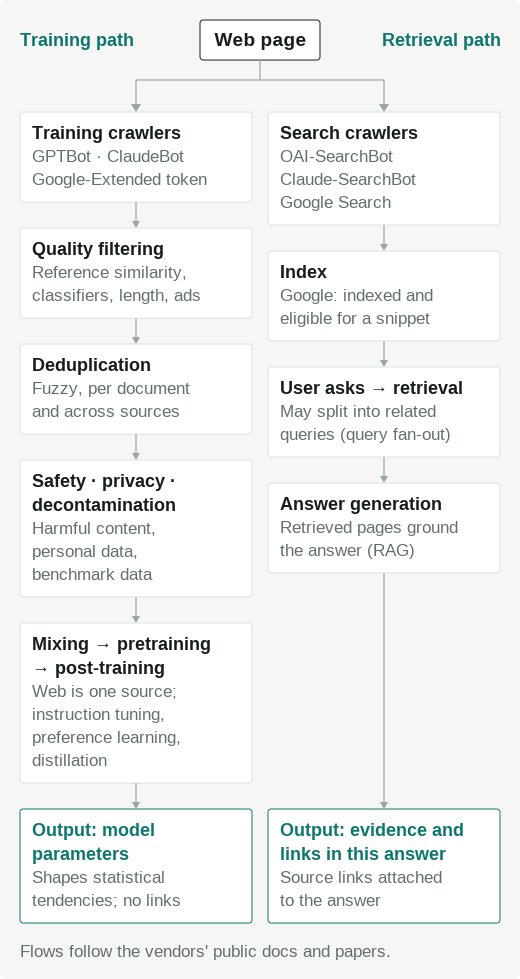
This is more than a conceptual distinction. All three vendors separate the two paths in their crawl controls:
- OpenAI's crawler documentation says GPTBot is used to make generative AI foundation models more useful and safe, and that disallowing it signals that the content should not be used to train foundation models; OAI-SearchBot is what lets a site appear in ChatGPT's search features. A site owner can allow OAI-SearchBot while disallowing GPTBot; the two settings are independent.
- Anthropic's crawler page lists three: ClaudeBot collects web content that may be used for training; Claude-SearchBot builds an index for search; Claude-User visits sites when a user asks Claude a question. Blocking ClaudeBot excludes the site's future content from training datasets; for the other two, the consequence the page gives is that visibility in search may be reduced.
- Google uses a product token, Google-Extended, to control whether crawled content is used to train future generations of Gemini models and whether it is used for grounding. The crawler documentation says it does not affect whether a site is included in Google Search and is not used as a ranking signal. Separately, according to the AI features page, for a page to appear as a supporting link in AI Overviews or AI Mode it must be indexed and eligible to be shown with a snippet in Search.
Google's case does not map neatly onto "training versus retrieval." Google-Extended covers Gemini grounding as well as Gemini training. The following is an inference from reading the two documents side by side; Google does not say it directly: display in Search's AI features is governed by indexing and snippet rules, and Google-Extended does not touch that.
| Training path | Retrieval path | |
|---|---|---|
| Crawl entry | GPTBot, ClaudeBot; Google controls it with the Google-Extended token | OAI-SearchBot, Claude-SearchBot, Claude-User; Google Search crawling and indexing |
| In between | Filtering, deduplication, mixing, post-training | Indexing, retrieval, ranking, generation |
| Output | Model parameters | Evidence and links in one answer |
| Time scale | Per model version | Per single query |
| What the owner can observe | Almost nothing | Crawl logs, referral traffic, citation records |
| What the owner can control | Whether to allow training crawlers | Whether pages can be crawled, indexed and shown with a snippet, and the content itself |
The last four rows of the table are this article's summary of the documents above.
Before training: four kinds of filtering in public disclosures
Closed-model vendors have not published their filtering thresholds, the share of each source, or their full pipelines. What follows uses only what has been written down publicly, grouped by type of operation rather than by vendor, because the useful question for a publisher is which kind of page drops out at which step.
Quality filtering
To improve the quality of Common Crawl, the GPT-3 paper did three things: filtered by similarity to a high-quality reference corpus; ran fuzzy deduplication at the document level, within and across datasets; and added known high-quality reference corpora to the training mix. The Common Crawl portion was 45TB of compressed plaintext before filtering and 570GB after. The paper does not say whether the 570GB is also measured compressed, so the two figures may not be on the same basis; they are given side by side here, with no ratio computed.
The PanGu-α paper is more specific. It collected nearly 80TB of raw data from Common Crawl, encyclopedias, news, e-books and other sources, and ended up with 1.1TB of Chinese text after cleaning. The rule-based cleaning stage removed documents with too few Chinese characters or too little text, identified and removed documents containing advertising by keyword, and stripped navigation bars. The filtering stage that followed removed harmful content with a sensitive-word list, removed ads and spam with a fastText classifier, and dropped low-scoring documents with a quality classifier.
More recent disclosures are less detailed but point the same way. The ERNIE 5.0 technical report says heuristic filters and model-based filters were used to remove low-quality and unsafe content. The Qwen3 technical report discloses that its multilingual data annotation system labeled more than 30 trillion tokens along dimensions such as educational value, domain, industry and safety, and used those labels for data filtering and mixing. Hugging Face's FineWeb is an example whose output can be inspected: 15 trillion tokens drawn from 96 Common Crawl snapshots, from which 1.3 trillion tokens of educational text were selected as FineWeb-Edu.
These filters look at features of the text itself: how much it resembles the reference corpus, what score a classifier gives it, how much body text it has, whether it carries ads. The following is an inference from PanGu-α's rules (the paper does not say whether the length check runs before or after navigation bars are stripped): documents that are too short are deleted whole, documents with ads are deleted whole, and navigation bars do not count as body text, so pages with thin body text made up mostly of navigation and promotion are more likely to be removed in a similar pipeline. No vendor has published its actual thresholds.
Deduplication
Lee et al. (2021) show the scale and consequences of duplicated data. Language models trained on the datasets they studied copied training data verbatim in more than 1% of their unprompted output; one 61-word English sentence appeared more than 60,000 times in the C4 dataset. Models trained after deduplication emitted memorized text about one-tenth as often, and reached the same or better accuracy in fewer training steps.
Of the training data disclosures cited here, four state that they deduplicate: GPT-3 runs document-level fuzzy deduplication, PanGu-α runs fuzzy deduplication across data sources, the Anthropic Transparency Hub states that its cleaning and filtering methods include deduplication and classification, and ERNIE 5.0 says it deduplicates at scale to prevent memorization artifacts.
For a publisher this has two implications. The first is an inference, based on the fact that the whole point of fuzzy deduplication is to merge near-duplicate text: if the same article is syndicated to many sites, deduplication will probably leave only a few copies, so more copies do not buy more weight. The second is stated in the sources: one explicit goal of deduplication is to reduce a model's verbatim memorization of specific text. Hoping a model will "remember a site's exact words" runs directly against how training is designed.
Safety, privacy and decontamination
OpenAI's explainer says that for the public web it uses only publicly available content and does not intentionally collect data from sources known to be behind paywalls or from the dark web; that before training it filters out hate speech, adult content, sites that mainly aggregate personal information, and spam; and that it does not intentionally collect personal information to train its models. The Gemma 3 model card says CSAM (child sexual abuse material) filtering was applied at multiple stages of data preparation, that automated techniques were used to filter certain personal information and other sensitive data, and that content was filtered for quality and safety in line with Google's policies.
Decontamination means removing evaluation benchmark data from the training set so the model does not learn the answers by heart; the ERNIE 5.0 report lists it. The GPT-3 paper records a case where it went wrong: the authors tried to remove overlaps with their evaluation sets, a bug in the filter missed some of them, and because training was so expensive, retraining was not feasible.
What matters for publishers here is not decontamination itself but what it says about the rhythm of training: the training data is fixed once during preparation, and even when a problem is found, training is not necessarily redone. In the public material reviewed for this article, there is no sign of a mechanism on the training path such as a per-page appeal or an update after re-crawling.
Mixing and the stages after it
The data that survives filtering is not used evenly either. GPT-3 added known high-quality corpora to its mix, and Qwen3's multi-dimensional labels feed both filtering and mixing. The web is also only one source among several. OpenAI lists three kinds of sources: information publicly available on the internet, information obtained through partnerships with third parties, and information provided or generated by users, human trainers and researchers. Anthropic discloses that recent Claude models (for example Claude Opus 5.5, released in September 2026) use public web information, public and private datasets, user data, and synthetic data generated by other models; the disclosures for Opus 4.7 and 4.8, released in April and May 2026, do not list user data. So data composition changes from one model version to the next, and the share of each source has not been published.
On scale, the 27B Gemma 3 model was trained on 14 trillion tokens and the 1B model on 2 trillion; Qwen3's pretraining data is 36 trillion tokens covering 119 languages and dialects.
The stages after pretraining sit further from the web. The InstructGPT route is supervised fine-tuning, human preference comparisons, training a reward model, and then reinforcement learning; Constitutional AI has the model critique and revise its own output against a set of principles and uses AI feedback for reinforcement learning. As the papers describe them, both aim to make the model follow instructions better and produce less harmful output, not to add new web knowledge to it. Qwen3 also designed strong-to-weak distillation for its lightweight models, in which small models learn from advanced teacher models; the report says this clearly beats running reinforcement learning directly on the small models, in both performance and training efficiency. It follows that for small models distilled this way, any influence a web page has is indirect, through the teacher model.
What it means for publishers
Putting these four kinds of filtering together, a publisher hoping to get into training data can infer four things. All four are inferences:
- It cannot be observed. In the public material reviewed for this article there is no channel to check whether a page made it into a given model's training set, or at which step it was filtered out.
- The cycle is measured in model versions. Data is fixed in batches during preparation; miss one round and you wait for the next training run.
- It produces no links. The parametric path delivers statistical tendencies. According to OpenAI's and Google's documents, citations with links in their products come from search features and the Search index.
- The bar is the same as on the retrieval path. Text that survives filtering and deduplication, meaning text that is mostly body content, not a near-copy of many other pages, and not spam or advertising, is also more likely to be used on the retrieval path.
Point 4 means there is nothing extra to do for the training path. The only real decision a publisher has on that path is whether to allow or block training crawlers. That is a question of permission, answered by whether you are willing to let your content be used for training. It is not the same thing as optimizing visibility.
For a publisher, the only thing to decide on the training path is permission; almost everything that can be optimized is on the retrieval path.
The retrieval path: what the public rules say
Google's generative AI optimization guide (last updated 2026-07-10) is the most direct document available. The main points:
- Generative AI search uses RAG (which Google also calls grounding), relying on the core Search ranking systems to retrieve relevant, fresh pages from the Search index.
- Query fan-out is a set of concurrent, related queries generated by the model to fetch more information.
- You do not need to create new machine-readable files, AI text files, markup or Markdown for this. You may create an llms.txt, but Google Search ignores it. There is no need to break content into small chunks, and no special schema.org markup to add.
- It encourages "non-commodity" content that goes beyond common knowledge, with a distinctive expert perspective or first-hand experience.
- Creating separate pages for every possible search variation, primarily to manipulate rankings or AI responses, violates the scaled content abuse spam policy, and a large number of pages does not make a site higher quality. Seeking inauthentic mentions "isn't as helpful as it might seem."
Google's spam policies (last updated 2026-08-28) put attempts to manipulate generative AI responses in Google Search within scope from the first paragraph, and the examples of scaled content abuse include using generative AI tools to produce many pages that add no value for users.
On OpenAI's side, the publisher FAQ (archived 2026-10-04; the original address now redirects to the ChatGPT Atlas shutdown notice) says any public website can appear in ChatGPT search; the crawler documentation says sites that opt out of OAI-SearchBot will not appear in ChatGPT search answers, though they may still appear as navigational links. Anthropic's corresponding terms are listed above.
Reading these rules next to the training side, two correspondences stand out.
The first is between non-commodity content and deduplication. Fuzzy deduplication and quality filtering on the training side deal with text that resembles a great deal of other text; on the retrieval side, Google calls content that restates common knowledge commodity content. They are not the same mechanism. What follows is an analogy, not something any of the documents say: both point at the same kind of text. A page that rewrites common knowledge in common phrasing is easily merged away on the training side, and on the retrieval side it has no reason to be picked on its own.
The second is between fan-out and variant pages. Fan-out splits one question into several related queries that are retrieved separately, which makes it tempting to build one page per sub-query. Google lists exactly that as a spam policy risk, and also says content does not need to be split into chunks. The matching practice is to give one page a clear answer, understandable on its own, for each sub-question it covers, rather than to add more pages.
Specific writing techniques (question first, conclusion first, explicit entities and so on) are covered by a seven-point framework in the earlier piece and are not repeated here. One addition is directional evidence from an academic experiment. The GEO paper (KDD 2024) tested a range of rewriting methods on a generative engine the authors built themselves, which took Google's top 5 results and generated answers with gpt-3.5-turbo. Adding quotations, adding statistics and citing sources each improved the "position-adjusted word count" metric by roughly 30–40% over the baseline; keyword stuffing scored below the baseline (17.7 against 19.3 on that metric). On a 200-query subset run on Perplexity.ai, adding quotations improved the same metric by about 22%. The paper also notes that effective strategies vary by domain. What it can show is that, in that experimental setup, verifiable evidence helped more than keywords. It cannot be taken as the ranking rule of any commercial engine.
Priorities
Combining the conclusions from both paths gives the order below. The order itself is this article's judgment; the Basis column says whether each item rests on a document, a paper's experiment or an inference.
| Order | Item | Basis |
|---|---|---|
| 1 | Search crawlers can reach the site; important pages can be indexed and shown with a snippet | Documents: Google's AI features page, OpenAI and Anthropic crawler docs |
| 2 | Check whether a CDN or WAF is wrongly blocking search crawlers | A recommendation inferred from Cloudflare's change of default |
| 3 | Decide on training crawlers separately, according to whether you want to license training | Documents (OpenAI says the two are independent); the Google part includes inference |
| 4 | Lead with body content and offer non-commodity information | Document (Google's guide); the correspondence with training-side filtering is inference |
| 5 | Back key conclusions with data, quotations and sources | Paper experiment; directional evidence |
| 6 | Maintain each fact in one place only, with its date and version | Inference |
| 7 | Earn genuine third-party mentions; do not buy or fabricate them | Document (Google's stance on inauthentic mentions); the positive effect is inference |
| Later | Chasing training data, syndicating to many sites, mass variant pages, treating llms.txt as a boost | See the sections above |
Items 1–3: crawlers and indexing
The table below sets out, from each vendor's documentation, what each crawler is for and what opting out does.
| Crawler / control | Documented purpose | Effect of blocking or using it |
|---|---|---|
| GPTBot | Making generative AI foundation models more useful and safe | Content should not be used to train foundation models |
| OAI-SearchBot | Showing sites in ChatGPT's search features | Not shown in ChatGPT search answers; may still appear as navigational links |
| ChatGPT-User | Actions a user starts in ChatGPT or a custom GPT | User-initiated, so robots.txt rules may not apply |
| OAI-AdsBot | Checking that pages submitted as ChatGPT ads are safe | Data collected is not used to train foundation models |
| ClaudeBot | Collecting web content that may be used for training | Future content is excluded from training datasets |
| Claude-SearchBot | Improving search result quality | Content is no longer indexed for search; visibility and accuracy in search may drop |
| Claude-User | Visiting sites when a user asks Claude a question | Content cannot be fetched for answers; visibility in user-directed search may drop |
| Google-Extended | Gemini training and grounding | Does not affect Google Search inclusion or ranking |
nosnippet, data-nosnippet, max-snippet, noindex | Limiting how content appears in AI Overviews / AI Mode | According to Google's docs, this is how display in those two features is controlled |
A few further details from the documents: OpenAI says its search systems take about 24 hours to adjust after a robots.txt update; Anthropic says its crawlers respect robots.txt and do not bypass CAPTCHAs.
If you decide to allow retrieval but refuse training, the table above can be written as follows (an example configuration to show the syntax, not a recommendation of that choice):
User-agent: GPTBot
Disallow: /

User-agent: ClaudeBot
Disallow: /

User-agent: *
Disallow: /admin/
Google-Extended is left out of the example because it also governs Gemini grounding. As the documentation describes it, blocking it affects whether your content is used for grounding in Gemini, so whether to add it needs to be weighed separately.
This site's own configuration can serve as a reference: its robots.txt is open to every User-agent and disallows only three back-office paths, /admin/, /cms-auth/ and /cms-api/. In other words, both training and retrieval crawlers are allowed.
A robots.txt that allows a crawler does not mean the crawler can actually reach the page. In a blog post on 2025-07-01, Cloudflare announced that it was changing its default to block AI crawlers (unless they pay for content); the post did not distinguish training crawlers from search crawlers. That leads to a recommendation: sites behind a CDN or WAF should confirm that their security settings are not blocking search crawlers they meant to allow. The log check described below can surface this kind of problem.
Items 4–6: the content itself
Item 4 has been covered in the two sections above. One addition, which is an inference from PanGu-α's cleaning rules: "lead with body content" is not only a layout question. If core facts appear only in images, pop-ups or components that need interaction to expand, the extracted body text may be too short and the whole document dropped under similar rules; on the retrieval side, those facts are also harder to extract as evidence.
Item 5 rests on the GEO paper, with the strength of evidence described in the previous section.
Item 6 is entirely inference. The reasoning: training data has a cutoff, so the version of a fact stored in the model's parameters may be out of date. The retrieval path can correct outdated information, provided the page with the current version can be retrieved and no older page on the same site says something different. If facts such as prices, versions or compatibility are scattered across several URLs that contradict each other, the retrieval system may hand the contradiction to the model along with everything else. The matching practice: maintain each fact on one page and link to it from the others; write "as of month and year" and the applicable version instead of "currently" or "the new version." A comparison of the two styles (illustrative example): "The new version supports more export formats" versus "Acme Export Tool 3.2 (released September 2026) supports two formats, CSV and Parquet, with a limit of 1 million rows per export." The second puts the subject, version, date and numbers in one sentence that still holds when read out of context.
Item 7: third-party mentions
What Google's documents give for this item is the negative side: seeking inauthentic mentions "isn't as helpful as it might seem," and manipulating generative AI responses falls within the spam policies. The positive side is inference: when the retrieved results include independent sources stating the same facts as the official site, the model has more than one piece of evidence to work with. What you can do is give real coverage, reviews and discussion something solid to rest on, such as citable raw data and a stable fact page, rather than manufacture mentions.
The items that come later
Chasing training data: see the section on what it means for publishers. Syndicating to many sites: fuzzy deduplication merges near-duplicate text. Mass variant pages: Google lists them explicitly under scaled content abuse. Treating llms.txt as a boost: Google Search ignores it. This site has an llms.txt at its root too, but according to Google it does not affect how the site performs in Google Search.
Measurement: look at the two paths separately
The training path: essentially unmeasurable
One thing you can do is ask a model questions related to your content with web search turned off, and see what its parameters retained. But the result cannot be attributed to any one page, and it cannot tell you at which step your content was filtered. At most it reveals a model's misconceptions about a topic: a diagnosis, not a metric, and the stability of the results has not been verified.
The retrieval path: crawling, traffic and citations
The design below is derived from the mechanisms described above and has not been validated by measurement.
At the crawl layer, look at server logs. Split visits by User-agent into three groups: training crawlers (GPTBot, ClaudeBot), search crawlers (OAI-SearchBot, Claude-SearchBot) and user-triggered agents (ChatGPT-User, Claude-User), and count visits to key URLs for each group. If search crawlers never show up even though robots.txt allows them, check the CDN and WAF first. User-agents can be spoofed, so serious counting needs extra verification of where requests come from.
At the traffic layer, look at referrals. ChatGPT adds utm_source=chatgpt.com to referral URLs automatically, so you can filter on it directly in your analytics tool. Google's guide mentions that Search Console provides reports on how content performs in generative AI features in Search and Discover. Note that being cited is not the same as being clicked; the article Websites Didn't Die; the Old Traffic Path Did goes into this, and the "ghost citation" research cited in the earlier piece also shows that a cited brand may not appear in the body of the answer.
The citation layer has to be sampled yourself. Fix a set of real questions that match the site's topics, ask them regularly under fixed conditions of product, language and account, and record whether the answer cites the site, which URL it cites, and whether it describes the site's content correctly. Answers change with time, model version and index, so one result is not enough to conclude anything; each question needs to be asked several times within the same period. The record can follow the table below (illustrative example; the data is made up and only shows the fields):
| Date (illustrative) | Engine | Question | Repeats | Times site cited | Cited URL | Described correctly |
|---|---|---|---|---|---|---|
| 2026-10-01 | Engine A | Question 01 | 5 | 2 | /en/blog/xxx/ | Yes |
| 2026-10-01 | Engine A | Question 02 | 5 | 0 | — | — |
| 2026-10-01 | Engine B | Question 01 | 5 | 1 | /en/blog/yyy/ | Partly |
Every metric should map to a decision, or it is not worth recording:
| Metric | How it is calculated | The decision it informs |
|---|---|---|
| Search crawler coverage | Share of key URLs visited by search crawlers | Whether to check robots.txt, the CDN and the WAF |
| Citation rate | Share of all answers to the question set that cite any URL on the site | Whether the content has entered the evidence set |
| Description accuracy | Share of answers mentioning the site's content that describe it correctly | Whether to revise or merge fact pages |
| Distribution of cited pages | Which URLs the citations concentrate on | The order of priority for internal links and updates |
| AI referral visits | utm_source=chatgpt.com and the Search Console reports | Whether citations turn into visits |
Controlled comparison
To test whether a particular rewrite works, use a paired design: choose pages with similar topics and similar current performance, pair them, rewrite only one page in each pair, then sample with the same question set in the same period and compare how citation rates change between the two groups. This design has not been validated by measurement either. Its main confounders are model version updates and index changes, which act on both groups at once; pairing is there to cancel out that part. The 30–40% improvement in the GEO paper was measured on a self-built engine; what this design would show on commercial engines is not yet known.
Limits
- The evidence is limited to public documents and papers visible on 2026-10-09. Vendor documentation changes; for example, Google's generative AI guide was last updated on 2026-07-10 and its spam policies on 2026-08-28, and the conclusions here are based on those versions.
- OpenAI's "How ChatGPT and our foundation models are developed" was checked against the full page on 2026-10-20. The original address of the publisher FAQ now redirects to the ChatGPT Atlas shutdown notice (it already did on 2026-10-14; the archived copy from 2026-10-04 is still the original page). The two statements cited from it rely on that archive; no replacement page from OpenAI was found.
- Disclosures on the training side can only say what was done, not the thresholds or proportions. Closed-model vendors have not published their full pipelines; Gemma 3 is an open model, and its data composition is not the full data composition of Gemini; GPT-3 (2020) and PanGu-α (2021) are early work and do not represent those vendors' current models; Anthropic's disclosures also differ between models. One vendor's practice cannot be generalized to every model.
- The GEO paper's conclusions come from its own experimental setup and are not the ranking formula of any commercial engine.
- This article does not cover how individual AI search products rewrite queries, rank results or choose citations internally; public material does not disclose enough about that.
- The order in the Priorities section, the positive effects of items 6 and 7, and all the methods in the Measurement section are derived from public mechanisms and have no experimental data behind them. The article also does not quantify the role of parametric knowledge in answers given without web access; it only explains why publishers can do little to influence it.
Writing note: Claude Opus 5.5 wrote, illustrated, fact-checked and translated it; the author chose to publish.
Comments
Comments are powered by GitHub Discussions. Sign in with GitHub to comment. Open the matching Discussion